SHRM CP Situational Questions Explained with Effective Answer Strategies in 2026
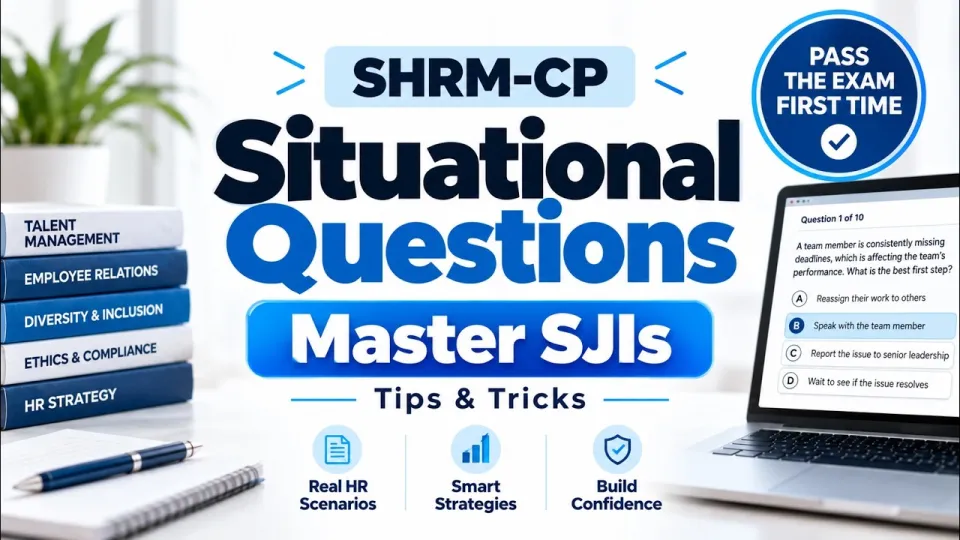
Video: SHRM CP Situational Questions (SJIs) | TIPS TO PICK THE RIGHT ANSWER
· based on the channel PrepSolution
SHRM CP Situational Questions require candidates to select the most appropriate response when multiple answers seem reasonable. These Situational Judgment Items (SJIs) evaluate an HR professional’s ability to navigate complex workplace scenarios by applying facts, policies, and interpersonal considerations effectively. To succeed in 2026, understanding how to dissect these questions and avoid common traps is essential.
Understanding SHRM CP Situational Questions
Situational Judgment Questions in the SHRM CP exam present a realistic HR challenge where you must decide the best course of action. Often, all four answer choices appear plausible, making it difficult to pick the correct one. The key is to identify whether the question targets the immediate next step, the most effective long-term solution, or best practice in HR.
Five Decision Checks to Pick the Right Answer
To evaluate each option effectively, apply these five critical decision checks:
- Examine the Facts: Does the answer reflect the scenario’s details accurately without assumptions?
- Consider Policy and Law: Is the action compliant with relevant laws, regulations, and company policies?
- Appropriate Escalation: Does the option involve escalating the issue correctly—neither too soon nor too late?
- HR’s Role: Is the response aligned with HR’s responsibilities without overstepping managerial duties?
- People Involved: Are the right stakeholders included or informed in the decision?
These checks help filter out responses that may seem correct but violate key principles or procedural norms.
Recognizing Common Answer Traps
SHRM CP situational questions often include answer traps designed to mislead. Identifying these traps helps avoid incorrect choices:
- Premature Action: Acting too quickly without gathering full information or following proper procedure.
- Passive Responses: Avoiding action when the situation requires proactive intervention.
- Taking Over Manager’s Responsibilities: HR should support but not replace supervisors in discipline or performance management unless necessary.
- Unnecessary Escalation: Escalating issues that can be resolved at a lower level wastes resources and can damage relationships.
- Legally Defective Options: Choosing actions that might expose the organization to legal risk or violate employee rights.
Practical Elimination Tips for SHRM CP SJIs
When faced with multiple plausible answers, use these elimination strategies:
- Match each option against the exact wording of the scenario; avoid relying solely on your personal workplace experience.
- Discard answers that skip important steps or violate company policy.
- Consider the timing of the action – is it the next logical step or an overreach?
- Remove alternatives that shift HR beyond its scope or ignore key stakeholders.
Example Scenario: Handling a Supervisor’s Request After a Shouting Match
In a typical question, a supervisor wants to discipline an employee after a heated confrontation. The answer choices may include immediate discipline, investigation, coaching, or escalating to higher management.
Applying decision checks, the best response might be to first gather facts objectively and assess the situation before recommending any disciplinary action. Prematurely disciplining without investigation is a common trap. Equally, ignoring the conflict or escalating unnecessarily can worsen the problem. HR’s role is to facilitate fair resolution aligned with policy and ensure appropriate involvement.
Helpful Links for SHRM CP Situational Question Practice
Итог
Mastering SHRM CP Situational Questions requires a structured approach: apply the five decision checks, recognize common answer traps, and use elimination based on scenario facts rather than assumptions. The detailed explanation and strategies from the PrepSolution channel provide valuable insights and practice opportunities to enhance your readiness for the exam. For further practice and comprehensive study materials, visit PrepSolution’s free SHRM-CP practice questions page.
Полезные ссылки
- https://prepsolution.com/free-practice/shrm-cp?utm_source=youtube&utm_medium=video&utm_campaign=shrmcp_longform&utm_content=cp_long_v09
- https://prepsolution.com/exam/shrm-cp?utm_source=youtube&utm_medium=video&utm_campaign=shrmcp_longform&utm_content=cp_long_v09
Key takeaways
- SHRM CP Situational Judgment Items (SJIs) test real-world HR decision-making skills.
- Five decision checks guide the best answer: facts, policy/law, escalation, HR role, and people involved.
- Common answer traps include premature action, passive responses, and unnecessary escalation.
- Effective elimination focuses on scenario facts, not personal workplace habits.
- Practice with Riverside Logistics scenario improves understanding of answer selection.
Questions & answers
What are SHRM CP Situational Questions designed to test?
They test an HR professional’s ability to handle realistic workplace scenarios by applying knowledge of facts, policies, legal considerations, and interpersonal dynamics effectively.
How do the five decision checks help in answering SHRM CP situational questions?
They provide a framework to evaluate options by considering facts, compliance with laws and policies, proper escalation, HR’s role, and involvement of the right people, ensuring a well-rounded decision.
What are common traps to watch for in SHRM CP Situational Judgment Items?
Common traps include premature action, passive responses, taking over a manager’s responsibilities, unnecessary escalation, and legally defective choices that could cause issues.
Where can I find free practice questions to prepare for SHRM CP Situational Judgment questions?
PrepSolution offers free SHRM-CP practice questions on their website, which include situational judgment practice and exam preparation materials at https://prepsolution.com/free-practice/shrm-cp?utm_source=youtube&utm_medium=video&utm_campaign=shrmcp_longform&utm_content=cp_long_v09.
Source: SHRM CP Situational Questions (SJIs) | TIPS TO PICK THE RIGHT ANSWER · Markdown version